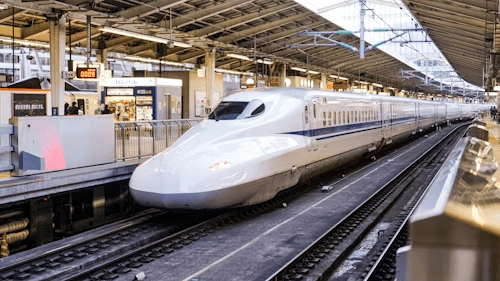
The origin of Teke Teke is a chilling urban legend from Japan that has captivated imaginations for generations. It draws inspiration from various cultural elements, including the country’s modernization and the development of its extensive railway system, including the bullet train.
One interpretation of the legend suggests that the character’s appearance and haunting nature are symbolic of the dangers associated with Japan’s rapidly advancing industrialization and urbanization, particularly during the post-war period when the country experienced significant economic groth and infrastructural development, including the introduction of high-speed bullet trains.
During the early days of the bullet train, officially known as the Shinkansen in Japan, there were several notable accidents that highlighted the risks associated with high-speed rail travel and the challenges of implementing such advanced transportation technology. One of the earliest and most significant accidents occurred on June 15, 1964, just nine days before the opening of the first Shinkansen line between Tokyo and Shin-Osaka. During a test run near Sakurazaka Station in Fukushima Prefecture, the newly built Hikari Express collided with a freight train that had mistakenly entered the same track. The collision resulted in the derailment of the Hikari Express and the death of the train conducter and a technician. This incident underscored the importance of rigorous safety protocols and thorough testing before the Shinkansen’s official launch.
Another notable accident took place on August 20, 1987, when the Akatsuki Shinkansen derailed near Maibara Station in Shiga Prefecture. The derailment was caused by a crack in the train’s wheel axle, resulting in seven fatalities and over 200 injuries. This incident prompted extensive safety inspections and upgrades to the Shinkasen fleet to prevent similar accidents in the future.
These accidents, among others, led to significant improvements in safety measures, infrastructure, and technology within Japan’s high-speed rail network. Today, the Shinkansen is recognized as one of the safest and most efficient railway systems in the world, with a remarkable safety record and millions of passengers traveling on its trains every year. However, the early days of the bullet train serve as a reminder of the challenges and risks involved in pioneering new transportation technologies.
The legend of Teke Teke embodies fears and anxieties related to the rapid pace of modernization and the potential dangers it brings, such as accidents and tragedies involving trains and railway tracks. The image of a young woman tragically severed by a speeding train resonates with the inherent risks associated with Japan’s bustling transportation networks, including the bullet train, which is known for its high speeds and efficiency.
Furthermore, the sound she makes as she drags herself along the ground, often described as “teke teke”, may evoke the sound of a train speeding along the tracks, further linking her to the railway system and the dangers it poses. In this way, the influence of the bullet train on the Teke Teke legend underscores the intersection of folklore, cultural anxieties, and technological progress in Japan’s modern society, creating a haunting narrative that continues to serve as a cautionary tale about the perils of progress.
According to the legend, Teke Teke is the vengeful spirit of a young woman who met a tragic fate on the train tracks. There are variations of the story, but the most common one tells of a girl who was either pushed onto the tracks or accidentally fell while running away from an attacker. In one story, it was during cicada season, and a group of bully classmates put an insenct on a girls shoulder, causing her to jump backwards into an on-coming train. Afterwards, the students all went home and pretended she’d just jumped herself.
A second popular variation involves a sexual assault which leaves her (sometimes referred to as Kashima Reiko) unconcious upon the train tracks. Eventually a bullet train comes along cutting her in half, but it was such a cold evening, she remains alive and is able to crawl quite a ways before finally passing away. In either case, she was severed in half by the speeding train, leaving her with only her upper body remaining.
In some versions of the legend, Teke Teke is said to roam the streets at night, dragging her upper body along with her hands or elbows, making a distinctive “teke teke” sound as she moves. It is said that if she catches you, she will slice you in half with a scythe or other sharp object (sometimes even long claws), mirroring her own gruesome demise. Others claim that she may appear to individuals who have witnessed her tragedy or have been disrespectful to the dead, haunting them until they meet a similar fate. In one version, she will ask the question, “Where is my body?” or “Where are my legs?”. The answer to this is Meishin Expressway and if answered incorrectly, she’ll attack.
Teke Teke has become a popular figure in Japanese horror culture, inspiring numerous urban legends, stories, manga, literature, movies and even a couple video games. Despite it’s relatively recent origins, the legend has undoubtedly influenced Japanese horror cinema and storytelling, contributing to the broader landscape. Her tale serves as a cautionary reminder of the dangers of wandering alone at night and the consequences of violence and cruelty. Whether she is a figment of the imagination or a restless spirit seeking revenge, Teke Teke continues to haunt the dark corners of Japanese folklore, sending shivers down the spines of those who dare to listen to her tale.
Below I’ve included some links if you’re interested in exploring Teke Teke a bit further:
Book:
Movie:
Video Games:
Sources:
Teke teke. Yokai.com. (n.d.). https://yokai.com/teketeke/
 Scare Me Please